
Your Doctor Probably Never Mentioned This
You step on the scale at your annual checkup. The number goes into your chart. Your doctor glances at it, maybe mentions your BMI, and moves on to blood pressure and cholesterol.
That’s it. That’s the entire conversation about your body composition.
Nobody measures how much of your weight is muscle. Nobody measures how much is fat. Nobody asks whether you can carry your groceries up the stairs without getting winded, or whether you can get off the floor without using your hands.
The scale tells you one thing: how much gravity is pulling on you. It says nothing about what you’re made of. And what you’re made of matters far more than the total number.
Most people go decades without a single measurement of their lean muscle mass. They diet, they exercise, they track calories. But they never actually know whether they’re gaining muscle or losing it. They’re flying blind.
That’s a problem. Because muscle may be the single most important factor in how long you live.
What the Research Actually Shows
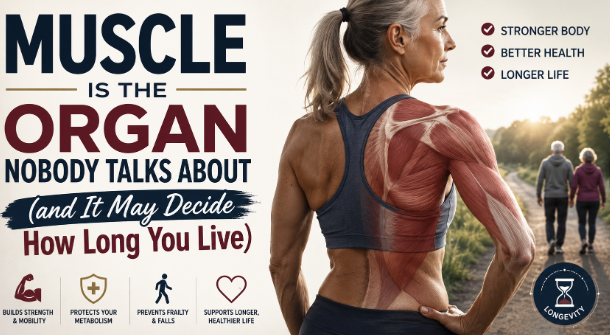
Muscle is a longevity organ. Not a vanity project. Not just something for athletes or bodybuilders. An organ that protects you from disease, keeps your metabolism running, and predicts how well you’ll age.
The research is remarkably consistent. People with more muscle mass live longer. People who are stronger live longer. The relationship holds across age groups, genders, and health conditions.
Low muscle mass is linked to higher rates of heart disease, type 2 diabetes, and metabolic syndrome. It’s connected to longer hospital stays, slower recovery from surgery, and greater risk of falls and fractures. Sarcopenia (the clinical term for age-related muscle loss) is now recognized as a medical condition in its own right, and it affects roughly 10% of adults over 50.
Think of muscle as your metabolic savings account. Every pound of lean tissue burns calories at rest, regulates blood sugar, reduces inflammation, and supports your immune system. The more you have, the more resilient you are.
Strength matters too, independent of size. Grip strength alone is one of the strongest predictors of all-cause mortality in older adults. Researchers have found it predicts health outcomes better than blood pressure in some populations.
This isn’t fringe science. It’s well-established. But somehow it rarely makes it into the conversation at your doctor’s office.
The Quiet Threats to Muscle After 40
Three things work against your muscle mass as you age. All of them are common. All of them are fixable.
Hormonal decline. Testosterone drops 1 to 2 percent per year in men starting around age 30 to 35. That slow, steady decline chips away at the body’s ability to build and maintain lean tissue. Women experience similar shifts during perimenopause and menopause, with drops in estrogen and progesterone that affect muscle preservation. These hormonal changes don’t announce themselves. They happen gradually, over years, until one day you notice you can’t do things you used to do without thinking.
Inadequate protein. Most people think they eat well. Most people are wrong. Protein intake is consistently lower than what the body needs to maintain muscle, especially after 40. The standard recommendation of 0.8 grams per kilogram of body weight is a minimum to prevent deficiency. It’s not enough to build or even hold onto muscle. Active adults and aging adults need significantly more, spread across multiple meals throughout the day. A muffin and coffee for breakfast, a salad for lunch, and pasta for dinner might feel healthy. But it leaves your muscles starving for the amino acids they need.
Caloric restriction that backfires. Eating too little is just as damaging as eating poorly. When you eat below your basal metabolic rate (the number of calories your body burns just to stay alive), your body goes into conservation mode. It slows your metabolism. It holds onto fat. And it breaks down muscle for energy. This is the opposite of what most dieters are trying to achieve. You can calculate your BMR online or get a precise reading from a body composition scan like the InBody, which measures fat mass, lean mass, and water distribution. Knowing your number changes everything about how you approach food.
Why Your Weight Loss Strategy Might Be Making Things Worse
Millions of people are actively losing muscle right now and celebrating it. Because the scale is going down.
Here’s what often happens. Someone decides to lose weight. They cut calories, sometimes drastically. They start doing more cardio. They skip the weights because they don’t want to “bulk up” or because the treadmill feels more productive. The scale drops. They feel good about it.
But a significant portion of that weight loss is muscle. Not just fat. Muscle.
Cardio-only exercise, calorie counting without protein targets, and rapid weight loss all sacrifice lean tissue. Your body doesn’t distinguish between “I’m dieting” and “food is scarce.” It just responds to the deficit by burning whatever is available, and muscle is often first on the list.
This problem is even more pressing with the rise of GLP-1 medications like semaglutide. These drugs are remarkably effective at reducing appetite and producing weight loss. But without resistance training, up to 40% of the weight lost on GLP-1 therapy can be lean muscle. Forty percent. That means for every 10 pounds someone loses, 4 of those pounds could be muscle they’ll desperately need later in life.
GLP-1 medications aren’t the villain here. The missing piece is resistance training. It’s non-negotiable, whether you’re on medication or not. If you’re losing weight by any method and you’re not lifting heavy things on a regular basis, you’re likely losing the very tissue that keeps you healthy and independent as you age.
A Simple Framework for Protecting Muscle at Any Age
You don’t need a complicated plan. You need a few habits done consistently.
Prioritize protein at every meal. Aim for 30 to 40 grams of protein per meal, three to four times a day. Organic chicken, grass-fed beef, wild-caught fish, bison, venison, elk. Eggs. Greek yogurt. Whatever protein sources work for your diet and your budget. The key is consistency across the day, not just loading up at dinner.
Lift weights three to four times per week. Resistance training is the single most powerful stimulus for building and maintaining muscle. Bodyweight exercises count. Dumbbells, barbells, machines, kettlebells, bands. Pick what you’ll actually do. Progressive overload (gradually increasing the weight or reps over time) is what drives adaptation. Walking is great for your heart and your mood. It will not save your muscles.
Track body composition, not just weight. Stop letting the scale be your only metric. Get a body composition measurement. An InBody scan, a DEXA scan, or even a skilled trainer with calipers can tell you what the scale cannot: whether you’re gaining muscle, losing fat, or both. This one shift in measurement changes how you think about your body and your progress.
Know your basal metabolic rate. If you don’t know how many calories your body needs at rest, you can’t make informed decisions about food. Eating below your BMR for extended periods is counterproductive. Your body fights back. A simple calculation or a body composition scan can give you this number, and it becomes your nutritional floor.
Be patient. Muscle takes time to build. Weeks. Months. The changes happen slowly, then all at once. You won’t see them on the scale, which is exactly why you need better measurements.
Start Now, Not Later
The best time to start building muscle was 20 years ago. The second best time is today. Every decade you wait makes the climb steeper, but the climb is always worth it
You don’t need to become a bodybuilder. You don’t need a gym membership, though it helps. You need to treat your muscle mass like the vital organ it is. Because the data is clear: the stronger you are, the longer you will live.
Your annual checkup measures your blood pressure, your cholesterol, your blood sugar. All important. But if nobody is measuring your lean mass, your strength, and your body composition, you’re missing the organ that might matter most.
Pick up something heavy this week. Eat more protein tomorrow morning. Get a body composition scan so you know where you stand. These are small steps. They lead somewhere big.
About the Author: Colin Renaud, PA-C practices at Med Matrix (medmatrixusa.com), a functional medicine clinic in South Portland, Maine. With fellowship training in functional medicine and a focus on longevity and metabolic health, he helps patients build strength and resilience at every age.